

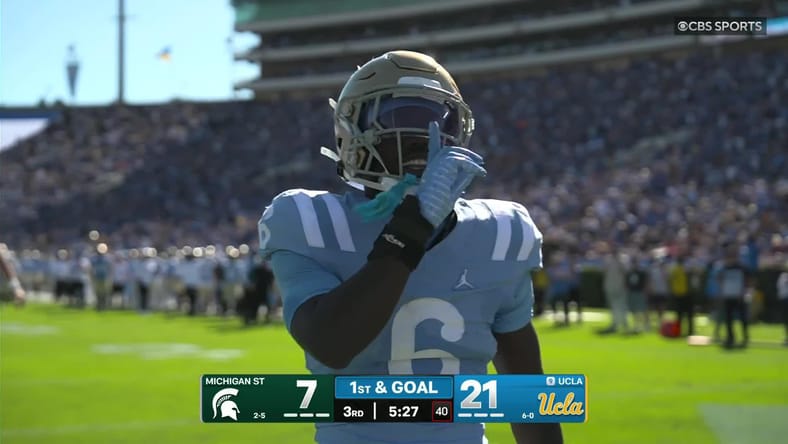
UCLA kept giving Michigan State opportunities. Its defense kept taking them back.
An uneven offensive start and two costly fumbles gave the Spartans a chance to threaten the Bruins’ unbeaten season Saturday at the Rose Bowl. But No. 9 UCLA answered with a defense that controlled the afternoon, pulling away for a 28-10 victory and its first 7-0 start since 2005. The Bruins improved to 5-0 in Big Ten play, currently atop the division and one of three FBS teams currently undefeated.
UCLA’s defense this season has been paramount in how they’ve won games, consistently creating turnovers, limiting opposing offenses and putting the Bruins in favorable positions. Through seven games, UCLA has allowed just 107 points (15.3 per game) and 1,910 total yards, including 1,277 passing and just 633 rushing. The Bruins have surrendered only 13 touchdowns, eight passing and five rushing, while forcing an impressive 22 takeaways with 12 interceptions and 10 fumble recoveries.
That dominance continued in Saturday’s 28-10 victory over Michigan State, as UCLA held the Spartans to a season-low 156 total yards, including 109 passing and just 47 rushing. The defense also recorded four sacks, six tackles for loss and three takeaways while holding Michigan State to 2-for-11 on third down. With UCLA improving to 7-0 for the first time since 2005, the defense has established itself as the backbone of the Bruins’ success, consistently controlling games and allowing the offense to operate without needing an explosive performance every week.
Michigan State finished with 156 yards on 54 plays, averaging just 2.9 yards per snap. UCLA produced 443 yards at 5.6 yards per play, nearly doubling the Spartans’ efficiency while holding the ball for 35:58.
The difference was especially clear when Michigan State needed to extend drives. The Spartans converted two of 11 third downs, continuing a stretch in which UCLA has allowed opponents to convert just 12 of 70 attempts over six games.
The Bruins also prevented the explosive gains that might have helped Michigan State escape those situations. The Spartans managed only one play of at least 20 yards and had just 83 total yards through three quarters.
Michigan State entered without quarterbacks Alessio Milivojevic and Cam Fancher, leaving freshman Kayd Coffman to start. That context matters when evaluating the performance, but UCLA still had to overcome the favorable field position its offense handed the Spartans.
An early fumble set up Michigan State’s opening touchdown. Neither offense found much rhythm afterward, trading punts while UCLA’s defense kept the deficit manageable.
Sammy Omosigho helped change that. After Malik Hartford forced a Kenneth Williams fumble, Omosigho recovered to give UCLA a short field. Jaivian Thomas finished the ensuing possession with a seven-yard touchdown run.
Another UCLA fumble threatened to undo that work. Instead, Donavyn Pellot intercepted Coffman and returned the ball 67 yards, setting up Wayne Knight’s one-yard touchdown and a 14-7 halftime lead.
That sequence captured the afternoon. UCLA’s offense created trouble, and its defense supplied both the escape and the opportunity to score.
Omosigho finished with six tackles, two sacks and the fumble recovery, strengthening his case as UCLA’s defensive MVP this season. Jalen Woods added nine tackles and a sack as the Bruins collected four sacks and three takeaways.
Ty Dieffenbach’s afternoon offered a similar mix of concern and progress. He was helped off the field late in the first half but returned after the break, converting a third down with his legs before connecting with Brian Rowe Jr. for a 63-yard touchdown.
He finished 18 of 31 for 198 yards, one touchdown and no interceptions.
Dieffenbach has generally given UCLA functional quarterback play through his first two starts. Saturday’s opening stretch showed an offense still searching for consistency. The touchdown to Rowe showed how valuable even one explosive passing play can be when the defense controls the other side.
And UCLA has the backfield depth to keep Dieffenbach from having to carry the offense.
Anthony Woods led the rushing attack with 112 yards on 14 carries, averaging 8.0 yards per attempt. Knight extended his streak to seven consecutive games with a rushing touchdown, while Thomas supplied UCLA’s first score.
Together, they give the Bruins three capable backs who can distribute the workload and keep the offense moving when one struggles to find room. Knight remains a reliable scoring option, but Saturday demonstrated why this running game extends beyond him.
That gives Dieffenbach a clear assignment: operate the offense, protect the football and make the throws that keep defenses honest. He does not need to create a highlight every possession. With this backfield and defense, efficient quarterback play can be enough.
The Rose Bowl sounded more engaged than it has in recent years, particularly as the defense repeatedly shut down possessions. There were still stretches when UCLA gave the crowd little to celebrate offensively, but the Bruins eventually found enough balance to take control.
The concern is how often they can afford to follow that script. UCLA survived its early mistakes against Michigan State because the defense kept answering. It cannot assume every opponent will leave those opportunities unclaimed.
At 7-0, the Bruins have positioned themselves to pursue a Big Ten title and a College Football Playoff berth. They have little room to squander that position over the next few weeks. Winning the games they should win will preserve their margin for the toughest remaining tests.
Dieffenbach does not have to win those games himself. He needs to keep the offense on schedule and let UCLA’s deepest strengths decide them.