

When Myles Garrett was unavailable for portions of Los Angeles Rams training camp, Josaiah Stewart received some of the first-team opportunities that normally would have belonged to the two-time Defensive Player of the Year. The promotion allowed Stewart to test the progress he made between his rookie season and Year 2, but his development was also taking place during the conversations surrounding those reps.
Garrett regularly shared details with the younger pass rushers, including the player who could take his place for a practice or reduce his workload during a game. Stewart could study Garrett’s pad level, setup, and rush plan, then ask why one of the most accomplished defenders in the NFL approached a rep a certain way. However, Garrett did not believe that helping Stewart meant teaching the younger player to imitate him.
“If there is something they want to improve, great,” Garrett told me. “If it is taking something from me, I am here for it, and I am happy to share that. But let us not take away from what got them here.”
Check Out Our Custom Los Angeles Rams Merch HERE!
That final sentence explains the part of the Rams’ player-development process that can be difficult to see from the result alone. Puka Nacua becoming a superstar after falling to the fifth round is the obvious headline, while Kevin Dotson developing into one of the NFL’s better guards after Pittsburgh traded him is one of the clearest reclamation stories. Those outcomes can make it seem as if the Rams possess a simple formula for turning overlooked or misused players into stars.
Their process is not that automatic, and their success rate is not perfect. Allen Robinson never became the receiver the Rams expected when they signed him, while Cam Akers and Van Jefferson had productive stretches without becoming long-term pieces of the offense. Arriving in Los Angeles does not save a career by itself.
What the Rams do well is establish the assignment, identify the traits that give a player a chance to succeed, and add the details needed to make those traits dependable. The staff is not trying to teach every player to solve the same football problem in exactly the same way. At its best, the development process enhances the qualities that got the player to the NFL while giving him enough clarity to use them without hesitation.
Rams Give Freedom Without Freelancing
“Playing free” was one of the phrases I kept hearing while talking with Rams defenders. Garrett used it after arriving from Cleveland, while Byron Young, Stewart, and Larrell Murchison described versions of the same feeling from different stages of their careers. The phrase caught my attention because freedom and assignment football can sound like opposing ideas, even though the players did not describe them that way.
Players still have rules within the defense, and a pass rusher cannot abandon an edge or a defensive back ignore a coverage responsibility because he thinks he sees an opportunity. The freedom comes from understanding the call well enough to react instinctively inside it. Coaches provide the structure and make each responsibility clear, but they do not need to control every movement once a player has earned their trust.
Stewart explained the balance more clearly than anyone else I asked.
“They do a good job of letting us do what we’re good at and allowing us to put our own flavor and style into the game,” Stewart told me. “As long as you’re in the right spot and doing your job, you have that flexibility to do what you want.”
Stewart entered the NFL with an established pass-rush identity, but the Rams needed to determine how that identity could function inside a deeper and more demanding role. He produced 12.5 sacks as a freshman at Coastal Carolina before transferring to Michigan, where playing within a line full of NFL talent required him to contribute without being featured on every down. His first Rams season placed him in another talented rotation, and he responded with 22 tackles, three sacks, and 21 pressures while appearing in every regular-season game.
Subscribe To Our Rams LAFB YouTube Channel!
The goal in Year 2 is not to replace the explosiveness and natural leverage that already make Stewart dangerous. It is to build enough coverage ability, run defense and tackling consistency around those traits to make him an every-down defender. Stewart summarized the work as “everything” because his daily improvement could involve a rush, a run fit, a coverage responsibility, or a different type of tackle.
Young described the same philosophy from a different perspective.
“Just let me be me. Let me play my playing style. That’s the reason that got me here,” Young told me. “They try to find ways to let me use my potential and everything in my ability to rush the passer. Let me do that. Let me rush freely. Sometimes, let me use my own flavor to it.”
Young entered the Rams’ edge room in 2023 beside Aaron Donald and quickly moved from the player absorbing veteran knowledge to one responsible for passing it along. During the 2024 camp, Young and then-rookie Jared Verse were almost always together between periods, talking through reps and learning how the other attacked an offensive lineman. Stewart is now part of that progression, learning behind Garrett and Young while receiving opportunities that could eventually make him responsible for another young pass rusher.
“Every player is different,” Young said. “You can’t teach them the same thing.”
The First Role Is Rarely The Final One
Development looks different for a player who is not competing for first-team snaps. Shaun Dolac arrived from Buffalo as an undrafted linebacker after leading the country in tackles, but college production did not guarantee him a defensive role in the NFL. His first path onto the Rams’ roster ran through preparation, assignment discipline, and special teams.
“My approach has been all about consistency and preparing the right way,” Dolac told me. “I make it a priority to understand each play call so I can play fast and confident. The way you earn trust in the room is making the most of every rep you get and doing your job correctly.”
The open portions of 2026 camp made that process especially difficult to evaluate. Unlike the previous two camps I attended, there was not a consistent third-team period where the players furthest down the depth chart received their own extended series. The second- and third-team players mixed together, with backups rotating constantly while the starters were largely established. It often felt less like separate units developing at their own pace and more like backups fighting to determine which of them would become the backups.
In that environment, special teams was not a demotion or a side assignment; it was often the clearest route to a job. Dolac made the initial roster as an undrafted rookie in 2025 and became one of the league’s most productive rookie special-teamers, even though the defensive opportunities that made him a star at Buffalo were limited.
“Special teams is huge for me,” Dolac said. “It’s where I can show the type of player I am. Coming from a place with a big role on defense, I understand that everyone has to earn their way.”
Jarquez Hunter entered the Rams’ offense with a similar understanding. The fourth-round running back had already waited behind Tank Bigsby at Auburn, then joined a room led by Kyren Williams and Blake Corum. Hunter told me the largest NFL adjustment was processing a larger playbook, but he kept returning to the fundamentals because those were what he would trust when fatigue made the game faster.
“If it’s my time, it’s my time,” Hunter told me. “If I have to wait, I just go out there, keep working hard, and do my job until it’s my turn.”
Hunter appeared in five games as a rookie, exclusively on special teams, and returned to a crowded backfield the next summer. Los Angeles eventually traded him to Miami for Tutu Atwell after other backs strengthened their cases during the preseason. His time with the Rams reinforces the limit of any development program: a player can accept coaching, improve, and make himself useful without receiving a permanent role from the team that developed him.
The responsibility of the staff is to give the player a realistic path rather than promise where it ends. Hunter believed the Rams made that path easier to understand because the coaches built relationships with their players, earned their trust, and simplified how they taught a difficult offense.
“They trust their players, and I feel like they build a great relationship with their players to try to teach them,” Hunter told me. “They make it as easy as they can to help us learn and pick it up faster.”
Dolac described the same support even more directly.
“Ever since the other rookies and I arrived, we have felt an overwhelming amount of support from the coaching staff and support staff,” Dolac said. “It doesn’t matter who you are. You can feel that they believe in giving you the tools and opportunities to succeed every day.”
Jordan Whittington gave the same idea a measurable shape on offense. The Rams selected him in the sixth round, but his first dependable role was not built around receiving targets. Whittington blocked, handled kick returns, and gave the coaches reasons to dress him before injuries created more opportunities at receiver. He led all rookies with 453 kickoff-return yards and earned a place on the PFWA All-Rookie Team as a special-teams player, then continued expanding his offensive responsibilities.
Omar Speights had to remain ready even longer. The undrafted linebacker did not play a defensive snap until Week 8 of his rookie season, when an injury opened the first window, but the extra film work he completed while waiting prepared him for the opportunity. One week later, Speights recognized where Seattle’s motion was directing an overtime fourth-and-one run and helped make the stop that kept the Rams alive. He started the final 11 games, including the playoffs, and finished the regular season with 67 tackles. The opening arrived because of an injury; Speights kept the role because he had prepared for it before anyone promised it would come.
Improvement Becomes More Specific
Once a player proves he belongs, development usually becomes smaller and more technical than fans realize. Ethan Evans arrived from Division II Wingate, won the Rams’ punting job as a rookie, and became a reliable specialist. By his fourth camp, the routine no longer felt as hectic as it did when every NFL expectation was new.
Familiarity did not remove the need for change. Evans spent the 2026 offseason shortening his steps because his longer approach was creating inconsistency in his get-off time and preventing him from producing the hang time he wanted. The adjustment was not about punting harder; it was about controlling his mechanics well enough to help the coverage unit perform its job.
That distinction is important because “getting better” can become another vague football phrase unless the improvement is attached to something specific. Stewart needs to become more dependable against the run and in coverage. Young has continued developing a fuller rush plan instead of relying on speed alone. Dolac had to process NFL motions, disguises, and offensive complexity quickly enough to play without hesitation. Evans needed to correct his steps.
The process also requires players to recover from the inevitable rep when the adjustment does not work.
“Football is like life – you’re going to make mistakes,” Evans told me. “Don’t let them get to you. Whatever bump in the road comes, keep moving forward.”
The Rams can correct a player’s footwork or assignment, but they also have to keep that correction from creating more hesitation. That is why playing free is the result of development rather than the absence of coaching. The player has repeated the technique, understands why it matters, and can move to the next rep without carrying the previous mistake with him.
Development Without Security
Although I have spent three years observing how the Rams teach and operate, I cannot personally compare their process with the rest of the NFL in the way Alex Johnson can after spending time with the Giants, Titans and Colts.
Johnson entered the league as an undrafted defensive back and moved between practice squads before joining the Rams. Each system required him to learn new terminology and responsibilities, but his versatility at outside corner, nickel and safety also gave him more ways to remain useful. The difficulty of learning several positions became the reason he could understand how the entire coverage fit together.
“If there is something I am really confused about, I will ask one of the vets or a coach,” Johnson told me. “Being able to play different positions can make it harder, but it also allows me to understand what a defense is trying to do, what a coverage adjustment means, and how to teach other players.”
Daily repetitions against Puka Nacua and Davante Adams also punished any hesitation in Johnson’s technique or communication. He described them as the best in the world but could feel himself improving while learning how they created separation.
Johnson had previously gone seven weeks without being signed, flying to workouts and wondering whether his NFL career had ended. The coaching, competition, and knowledge he gained remain part of his development even though the Rams did not guarantee the next step.
“One of the basic building blocks of discipline is finding joy through the mundane or monotonous things in life,” Johnson said. “I look at this like it is my job, because it is. I am going to show up early, leave late, and make sure everything is in order.”
Persistence is not separate from career development for players living near the roster bubble. It is one of the skills the job requires.
Reclamation Is An Extension Of The Same Process
Kevin Dotson, Emmanuel Forbes Jr. and Baker Mayfield arrived in Los Angeles at different points of their careers, but none needed the Rams to invent ability that had never existed. They needed a staff to find a better use for it.
Pittsburgh traded Dotson before the 2023 season after he had moved between guard spots and fallen out of its long-term plans. The Rams settled him at right guard, reduced his hesitation, and emphasized the power and movement skills that made him a fourth-round pick. He quickly developed into one of the league’s highest-graded guards, turning a trade for a late-round pick swap into a long-term starting job.
Forbes required a different kind of intervention after Washington released the former first-round corner less than two years into his career. The Rams gave him time to add functional weight, understand the defense, and rebuild his confidence before asking him to carry a major role. He responded in 2025 with 18 passes defended, tied for third in the NFL, and during the final open practice of the following camp I watched him break up a deep Stafford pass intended for Adams. His season was meaningful progress rather than proof that every concern had disappeared, which is why the Rams continued adding competition around him.
Mayfield’s stay lasted only five games, but the Rams simplified his immediate assignment and trusted what he already understood when he arrived during the 2022 season. Los Angeles did not single-handedly revive his career, although that short stretch helped restore confidence and gave the rest of the league evidence that the ability behind his earlier success remained. Tampa Bay provided the permanent opportunity; the Rams helped reopen the path toward it.
Darrell Henderson Jr. described the shared idea behind those different cases.
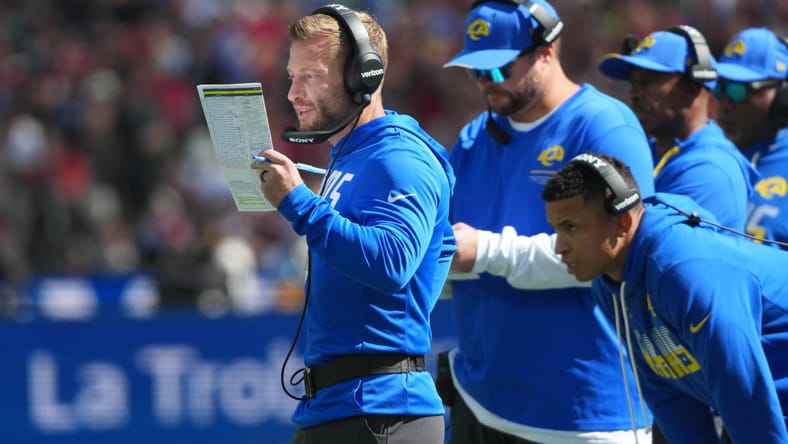
“Coach McVay does a good job of finding out what you’re good at and what you’re bad at, and he puts you in the best position to win,” Henderson told me.
That can sound like something every coach would claim, but the value of the Rams’ approach is visible in how differently they apply it. Dotson needed role clarity, Forbes needed technical work and confidence, Mayfield needed a manageable plan, while Stewart and Young needed room for their individual styles. Reclamation works when the team identifies the actual obstacle and the player accepts the work required to address it.
What Playing Free Requires
The Rams cannot guarantee a roster spot, a starting job, or a career revival. What they can provide is a clearly defined role, honest coaching, access to accomplished teammates and enough freedom within the scheme for players to use the traits that brought them into the league.
Playing free is not permission to freelance. It is what happens when the assignment becomes clear enough, the fundamentals dependable enough, and the trust strong enough that a player no longer has to choose between doing his job and playing like himself.