

The Los Angeles Rams made a quiet but telling move this week, re-signing veteran offensive lineman David Quessenberry to a one-year deal.
On the surface, it’s a depth signing. Quessenberry, 35, appeared in 13 games in 2025 and logged just 18 offensive snaps while contributing primarily on special teams. But when viewed through the lens of roster construction—and recent injury history—the move says far more about where the Rams believe their offensive line still needs protection.
Subscribe to LAFB Network’s Los Angeles Rams YouTube Channel
Insurance at Tackle — Especially With Alaric Jackson’s History
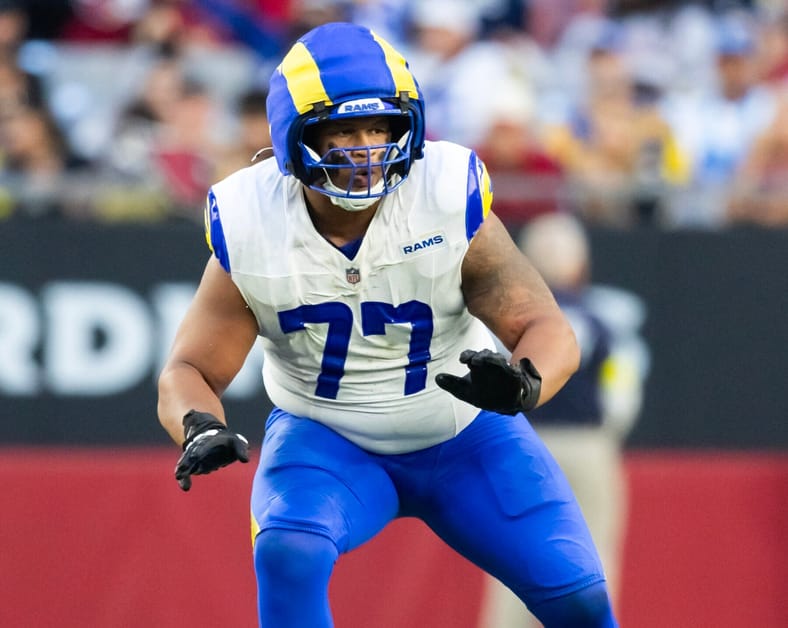
One of the biggest underlying questions involves left tackle Alaric Jackson.
Jackson battled blood clot issues during the 2025 season—something head coach Sean McVay acknowledged required careful medical management. This is not the first time Jackson has dealt with the condition, having missed significant time in 2022 for the same issue.
The Rams signed contingency options before, and bringing back Quessenberry continues that pattern of protection rather than panic. It does not necessarily signal a setback, but it reinforces that the team must plan for availability uncertainty at one of the most important positions protecting Matthew Stafford.
Simply put: the Rams cannot afford to be thin at tackle again.
Support Local and Independent Sports Writing – Subscribe To the LAFB Network Today!
A Wide-Open (ish) Competition at Right Tackle
The retirement of Rob Havenstein leaves a major leadership and performance void on the right side.
Quessenberry has played 95.4% of his offensive snaps at tackle from 2022–2025, confirming he is viewed league-wide as a true swing tackle rather than an interior option. That makes him a natural participant in what now projects as a training camp battle with Warren McClendon, who filled in admirably during Havenstein’s injury absence last season.
This signing doesn’t hand Quessenberry the job—it ensures the Rams have:
- A veteran floor
- A developmental ceiling in McClendon
- Real competition at a position that was previously stable for nearly a decade
That’s a classic McVay-era roster tactic: force competition while protecting against volatility.
Get LAFB’s World Famous ‘Ring Me’ Aaron Donald T-Shirt
Not a Guard Solution — But Emergency Flexibility Matters
While Quessenberry has logged some guard snaps, only 4.6% of his offensive plays came inside. He has never played center in the available data. His value is clearly as a bookend reserve capable of stepping in on either side.
That matters because the Rams already tested their interior depth in 2025—and it was uneven.
When injuries hit Steve Avila and Kevin Dotson, backup Justin Dedich was forced into extended action. Dedich showed adequate pass protection but struggled as a run blocker, finishing with:
- Negative run-blocking EPA (-0.118 per play)
- Lowest success rate (44.92%) among the three interior options
- Nearly double Dotson’s pressure rate in pass protection
The Rams learned a hard lesson in 2022 about how quickly offensive line injuries can derail a season. Quessenberry gives them a stabilizing emergency option if multiple injuries strike again.
Call it institutional PTSD—but justified.
Center Remains the Biggest Long-Term Question

If this move answers depth concerns, it also highlights what remains unresolved—center.
Coleman Shelton delivered a fascinating 2025 profile:
- Ranked 15th of 49 centers in pressure rate allowed (2.56%) — above average in pass protection.
- Posted elite traditional run metrics, including 5th in yards per block (4.75) and 1st in run success rate (48.42%).
- But ranked 34th in sack rate allowed, showing inconsistency when pressure did occur.
Shelton was effective, but not dominant. And with Dotson also managing health concerns, the Rams’ interior still lacks the kind of certainty they once had with a fully healthy unit.
The Real Message Behind the Signing
Re-signing Quessenberry is less about adding a starter and more about raising the offensive line’s survival floor.
The Rams appear to be prioritizing:
- Tackle insurance amid Jackson’s medical history
- A legitimate right tackle competition post-Havenstein
- Veteran depth to avoid another injury spiral
- Time to evaluate whether their long-term answers at center and guard are already on the roster
It’s not a flashy move. It’s a pragmatic one.
And for a team still built around Stafford’s window, stability up front may matter more than splash.