

The Los Angeles Rams came up just short in Week 13, falling to the Carolina Panthers, 31-28. While the defeat stings, defensive end Kobie Turner views it as a source of motivation rather than a setback.
“Honestly, I’m excited about where we go from here,” Turner said. “Gives you a little extra motivation to make it right this next week. I feel sorry for who we got next week.”
Linebacker Byron Young echoed that sentiment, recognizing the humbling nature of the game while focusing on growth. “I feel like it was a humbling experience, definitely something we needed,” Young said. “Gotta build off this, just gotta stay hungry.”
Panthers’ Rushing Attack Dictates the Game
Support Local and Independent Sports Writing – Subscribe To the LAFB Network Today!
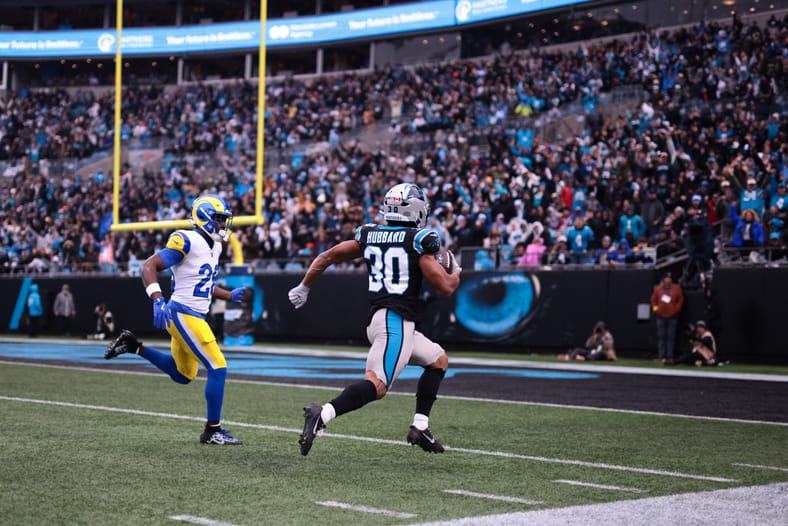
Carolina’s victory was built on a deliberate and disciplined commitment to the run. The Panthers ran 40 times compared to 22 pass attempts, controlling 64.5% of offensive plays on the ground. By contrast, the Rams leaned pass-heavy, rushing only 21 of 51 offensive plays (41.2%).
The Panthers’ ground game generated 164 rushing yards, with Chuba Hubbard leading the way with 17 carries for 83 yards and five first downs. Rico Dowdle’s 18 attempts for 58 yards and Bryce Young’s 5 carries for 23 yards created a balanced and unpredictable ground threat that consistently kept the defense off balance.
Quarter-by-quarter analysis highlights Carolina’s discipline. Their second and third quarters featured 25 rushes for 139 yards, including 8 first downs, demonstrating their commitment to sustained drives. The third quarter, in particular, saw 16 rushing attempts versus only four passes, cementing the Panthers’ strategy to control the clock and keep Matthew Stafford off the field.
Rams Defensive Struggles Without Lake
This Puka-Flex T-Shirt Is Illegal In Philly
The absence of safety Quentin Lake proved critical. Lake’s versatility as a communicator, deep coverage presence, and run-defending force had become the backbone of the Rams’ defense. Without him, Carolina exploited gaps in both the secondary and front seven.
Through Weeks 1–12, the Rams generated pressure on 39% of dropbacks, but against Carolina, this dropped to 25%, limiting disruption and allowing Bryce Young to operate comfortably. Young finished 15-of-20 for 206 yards, three touchdowns, and no turnovers — a stat line that would have been improbable against a fully equipped defense.
Corners Emmanuel Forbes Jr. and Cobie Durant struggled under these conditions. Forbes allowed five catches for 110 yards and two touchdowns, including a 43-yard game-winning connection with Tetairoa McMillan. Durant allowed 66 yards and a touchdown on five receptions. The lack of pressure magnified their limitations, exposing a secondary highly dependent on front-seven performance.
Base vs. Nickel: How Personnel Decisions Played a Role
Subscribe to LAFB Network’s Los Angeles Rams YouTube Channel
The Rams deployed seven different defensive personnel packages during the game, with base defense on 40.3% of plays, nickel on 45.2%, and dime on just 14.5%. The 4-2-5 nickel package was the most used, featuring four defensive linemen, two linebackers, and five defensive backs on 27.4% of snaps.
Season-long trends show that the Rams’ base defense usage has been highly variable — from a low of 5.4% in Week 7 to a high of 46.7% in Week 10. Week 13’s 40.3% base usage reflects the team’s attempt to adapt to Carolina’s heavy rushing commitment, but the shallow depth along the defensive line made it difficult to sustain pressure over multiple series.
Turner emphasized the learning opportunity while detailing the strategic challenges the Rams faced:
“Yeah, I think one of the big differences is they were able to stay on track. We got to do a much better job on first and second down to get them into those third-and-long situations and to really make him have to sit back, get through his progressions, and give us some more time to get there.
“We knew they had a very strong run game. They did some good work on the ground. We’re going to have to go back and clean that up. They’re not a team that gets in second and long and automatically passes the ball. We need to earn the right on early downs, get them behind the sticks, and really make them play from behind. Then we can go and get after the quarterback.”
This quote highlights the Rams’ approach: forcing early-down mistakes, creating third-and-long situations, and relying on their pass rush to dictate the coverage scheme. The Panthers’ ability to run effectively on first and second downs neutralized that strategy and wore down Los Angeles’ defensive line over the course of the game.
Situational Football: Why Early Downs Hurt the Rams
Carolina’s effectiveness on early downs forced the Rams to play honest football. By converting 5 first downs on second down and maintaining possession with 40 total rush attempts, the Panthers limited third-and-long opportunities where the Rams’ pass rush could dominate.
The strategy wore down the Rams’ defensive line, exposing vulnerabilities in both individual matchups and scheme execution. With linebackers and defensive ends having to defend extended series against the run, fatigue set in, reducing efficiency in both pass-rush and coverage situations later in the game.
Lessons and Lookahead
Despite the loss, the Rams remain 9-3 and in strong playoff position. The defeat underscores the fragility of a defense that relies heavily on pressure to cover secondary limitations. When front-seven disruption falters, opponents can exploit mismatches and control tempo — as Carolina demonstrated.
Looking ahead, the Rams will face the Arizona Cardinals for a crucial matchup. Arizona, now led by Jacoby Brissett after replacing Kyler Murray, presents an opportunity for both revenge and a test of adjustments. Turner and Young are ready to apply the lessons learned.
“Setbacks are setups for a greater comeback,” Turner said. “This was a humbling experience, but we have the right type of people in this building to take it and use it as an opportunity to get better.”
Conclusion
Carolina’s commitment to the run forced the Rams to abandon their primary strength: rushing the passer. Sustained ground control exposed defensive weaknesses, limited pressure on Bryce Young, and wore out a thin defensive line, ultimately handing the Panthers a hard-fought 31-28 win.
For Los Angeles, the loss is a reminder of the margins in the NFL and the importance of maintaining depth, adaptability, and resilience. As the Rams recalibrate, the challenge will be integrating lessons from Week 13 while preparing to reclaim control in upcoming matchups.