

The Los Angeles Rams have turned one of their historically weak areas—the goal line—into a potent scoring weapon in 2025. After a 2024 season where red-zone struggles often hindered them, the Rams’ offense has evolved into a precision machine inside the five-yard line, blending elite talent, clever scheming, and high-level execution.
Evolution of the Goal Line Attack
Through 25 goal-line plays this season, the Rams have scored 14 touchdowns for a 56.0% success rate. While they still favor running the ball—15 carries versus 10 passes—they have effectively balanced the threat, making defenses guess and creating mismatches in tight spaces.
Wide receiver Davante Adams has emerged as the linchpin of their goal-line success. Targeted on 7 of 10 passing attempts within five yards, Adams has hauled in six touchdowns, posting an 85.7% catch and touchdown rate per target. Tight end Tyler Higbee and rookie Puka Nacua have also contributed efficiently, each converting their lone targets into scores, while Davis Allen remains without a goal-line reception.
Rams offensive coordinator Mike LaFleur explained the strategy succinctly:
“A lot of times when you’re running the ball down there, there’s so much space that doesn’t get used, and with the opponent bulking up to stop the run, we’re seeing a lot of single coverage. And particularly with our skill players, if you’re going to give us one-on-ones, we’re going to take it.”
This approach reflects a significant shift from 2024, when the Rams’ goal-line play-calling heavily favored the run, and success often relied on brute-force execution rather than matchup exploitation.
Support Local and Independent Sports Writing – Subscribe To the LAFB Network Today!
Running Game Dynamics
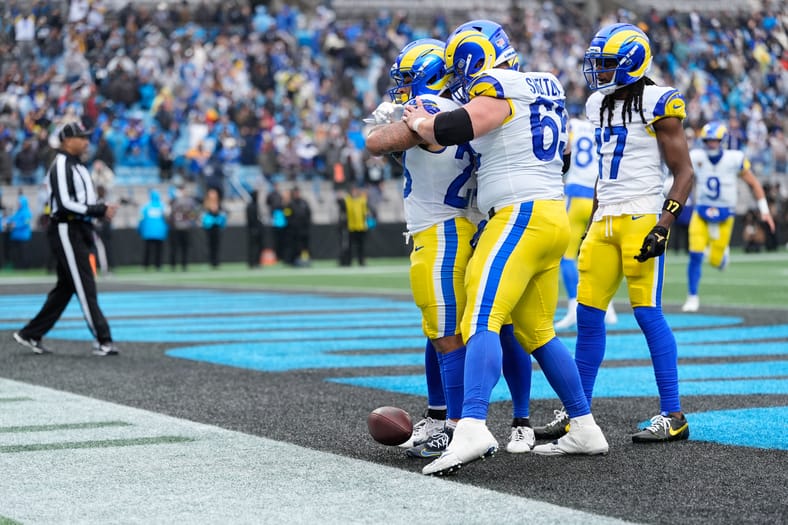
Despite the emphasis on passing, the Rams’ backfield remains a key component. Kyren Williams leads the ground attack with eight carries and four touchdowns, while Blake Corum contributes five carries and two scores. While their gap/power concepts are less efficient than last year—man blocking success has dropped to 33.3%—the Rams have diversified with zone and pull-lead schemes, both converting at 100% on their limited attempts.
LaFleur highlighted the strategy behind rotating Williams and Corum:
“We’ve been seeing the best version of Williams because he’s fresher and not being asked to carry as much of the load. We’re targeting January and February games and want everyone as fresh as possible.”
This rotation also benefits fantasy managers. Both backs remain highly usable, with neither showing signs of a workload tilt that could limit production.
This Puka-Flex T-Shirt Is Illegal In Philly
Matthew Stafford’s Precision

Quarterback Matthew Stafford remains the central piece of the goal-line success story. Of his 32 touchdown passes this season, 22 have traveled 10 yards or less, with nine within five yards and six just a single yard. Stafford’s ability to place the ball where only his receivers can catch it—especially Adams—has been critical.
Derrick Brown, Panthers defensive tackle, underscored the point:
“You only get that kind of green light if you’ve been in the league as long as Stafford has.”
LaFleur emphasized the trust factor that allows Stafford to take calculated risks:
“If you can run a fade and a slant, you’re going to be unstoppable in the red zone. Matthew takes chances because he can, because he’s earned that right.”
The pairing of Stafford’s accuracy and Adams’ route precision has transformed the Rams’ inside-five-yard efficiency.
Subscribe to LAFB Network’s Los Angeles Rams YouTube Channel
Red Zone and Goal Line Metrics
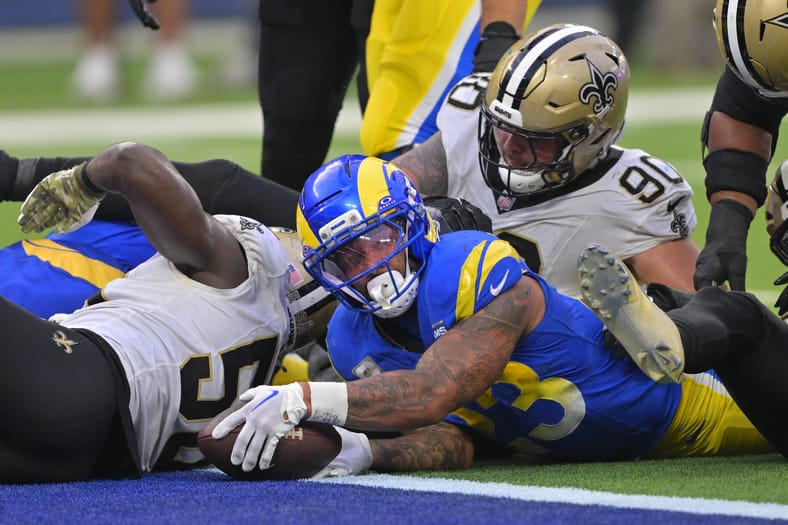
Comparing 2024 to 2025, the Rams’ red-zone efficiency tells the story of improvement and adaptation:
- Total Red Zone Plays: 12 per game (2024: 10.6)
- Touchdowns: 35 (+2 from 2024)
- TD Percentage: 24.3% (+6.1%)
- Passing Rate: 56.3% (+10.4%)
- Rushing Rate: 43.1% (-8.8%)
Passing touchdowns within the red zone have risen from 18 to 26 (+10.4%), highlighting the strategic pivot toward utilizing Stafford’s arm and elite receiving talent. Rush touchdowns have decreased, but this is offset by the efficiency gains through the air.
At the goal line specifically, their 25 plays represent an increase from 14 in 2024, but touchdown percentage slightly dipped from 64.3% to 56.0%. The real evolution lies in passing efficiency—Adams’ arrival has nearly doubled the Rams’ goal-line passing touchdowns from last year.
Balanced Yet Targeted
The Rams’ directional tendencies show thoughtful balance: seven attempts left (42.9% success), six right (50%), and two up the middle (0%). Running backs and receivers are strategically deployed to exploit single coverage while Stafford maximizes placement in tight windows.
LaFleur’s willingness to adapt in-game is evident: when a defender clogs one side, the quarterback and receivers can shift targets or rely on running backs for short scores. This flexibility makes LA nearly unstoppable inside the red zone, particularly with a healthy Adams and rotating backfield.
Looking Ahead
While overall goal-line efficiency has room for improvement, the Rams’ offensive philosophy in 2025 reflects an evolved, smart approach. They’ve embraced pass-heavy red-zone schemes, leveraged elite receiving talent, and maintained a reliable running back rotation. Stafford’s experience and decision-making, combined with LaFleur’s scheming, have converted a historically fatal weakness into a distinct strength.
As the postseason approaches, opponents will face a Rams team that can punish defenses in short-yardage scenarios without sacrificing overall red-zone efficiency—a dramatic turnaround from the struggles that haunted LA in 2024.