

When the Los Angeles Rams lost to the Seattle Seahawks, the result mattered in the standings. But for the Atlanta Falcons, the film revealed something just as important: a shift in how Sean McVay’s offense operates without Davante Adams.
Veteran safety Jessie Bates III noticed it immediately.
“They’re playing well,” Bates said, via Falcons beat writer Terrin Waack. “With Davante Adams out last week, they showed a little more want to run the ball. That’s always what they want to do. But you see a lot of big people last week with them trying to run the ball.”
That observation aligns directly with the numbers—and it sets the tone for Monday night’s matchup.
Support Local and Independent Sports Writing – Subscribe To the LAFB Network Today!
Rams Lean Heavier on the Run Game
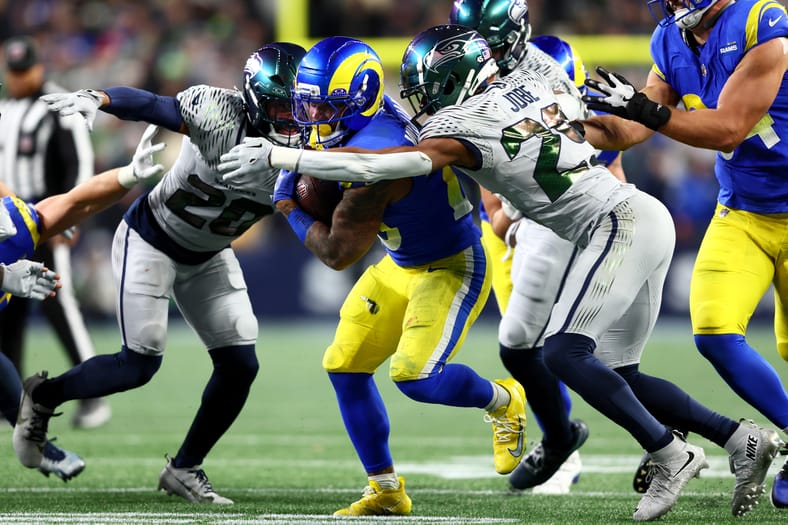
Los Angeles has long valued balance, but the Rams have leaned even more aggressively into their ground attack in recent weeks. Against Seattle in Week 16, they deployed 13 personnel (one running back, three tight ends, one wide receiver) on more than 61 percent of their offensive snaps, a dramatic increase compared to earlier in the season.
The Rams have used both 11 and 13 personnel almost evenly in the run game overall, but each grouping tells a different story:
- 11 personnel has produced more explosive runs (14.0%) and higher yards per carry (5.22).
- 13 personnel, while less efficient on a per-carry basis (4.72 YPC), has generated a stronger EPA per play (0.10), suggesting more consistent offensive value.
With multiple tight ends on the field—Colby Parkinson, Terrance Ferguson, and Davis Allen all heavily involved—Los Angeles has been able to dictate physicality and control tempo, especially when Adams is unavailable.
Subscribe to LAFB Network’s Los Angeles Rams YouTube Channel
Where the Rams Are Most Dangerous
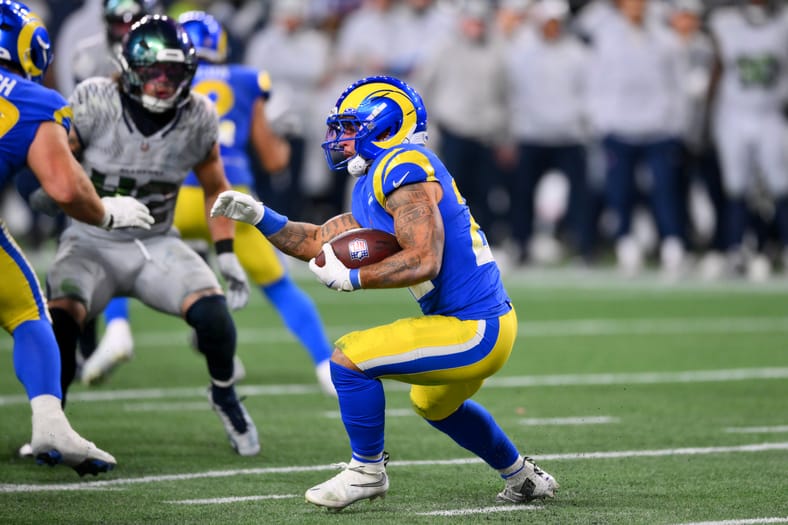
Regardless of personnel grouping, one trend stands out: Outside Zone runs are the Rams’ most effective concept. Both 11 and 13 personnel groupings have found success on the edge, producing strong yards per carry and success rates.
That versatility allows McVay to toggle between spacing-heavy looks and condensed formations without sacrificing efficiency. Kyren Williams and Blake Corum have benefited from that flexibility, particularly when defenses are forced to respect play-action and misdirection.
Falcons Run Defense: Strengths and Cracks
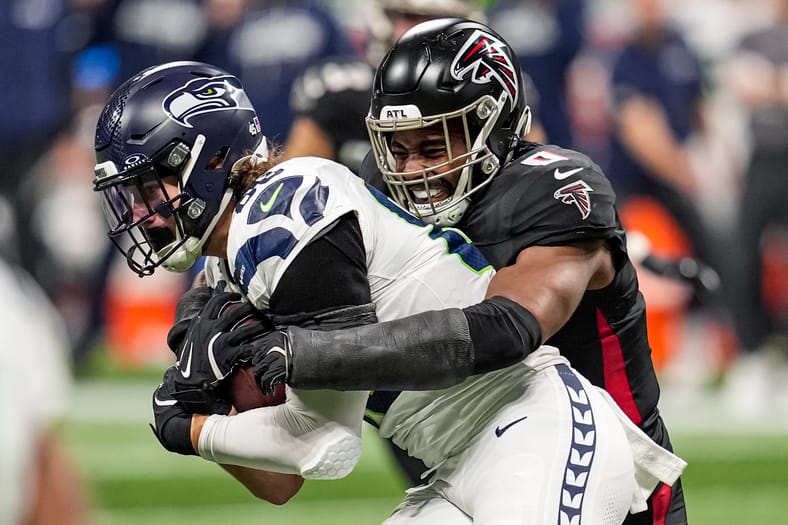
Atlanta’s run defense has been serviceable, but far from dominant. The Falcons allow slightly more yards per carry and explosive runs than league average, though they perform better when it comes to limiting overall success and EPA.
The concern comes against gap-based run schemes.
Atlanta has struggled most against Counter, Power, and Duo concepts—runs that thrive out of heavier personnel groupings. Against gap runs overall, the Falcons allow 5.28 yards per carry, with Counter runs being especially damaging.
That creates a clear pressure point. If the Rams continue leaning into heavier looks without Adams, Atlanta must win at the point of attack and stay disciplined with run fits—particularly when Los Angeles mixes in Duo and Counter off condensed formations.
Get your Puka-Flex T-Shirt Here
A Physical Test Without Adams
Bates’ comment wasn’t just observational—it was a warning. Without Adams stretching defenses vertically, the Rams have leaned into size, tight ends, and physicality to move the ball. That approach plays directly into the central battle of this matchup.
If Atlanta can force the Rams away from their preferred gap concepts and funnel runs toward Outside Zone—where the Falcons have defended more effectively—it could disrupt McVay’s plan. If not, Los Angeles may once again control the game on the ground.
Either way, the Falcons know what’s coming. The question now is whether they can stop it.