

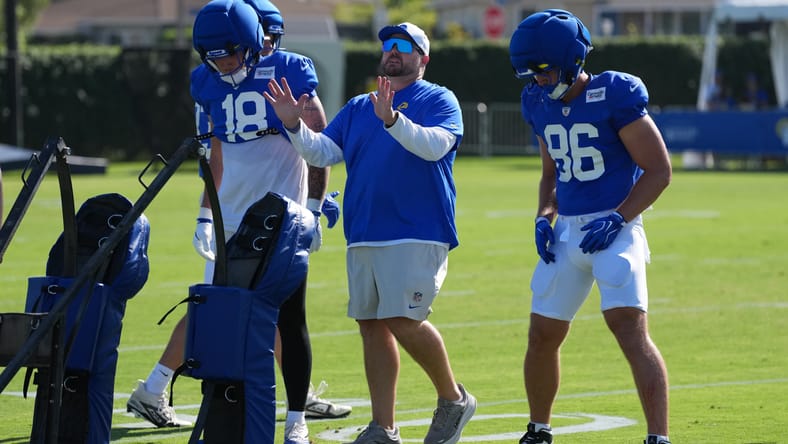
Across the two Los Angeles Rams training camp practices I attended at Loyola Marymount University, the biggest takeaway was not one catch, throw or individual performance.
It was how complete the roster already appears.
The Rams have established starters, experienced depth and young players competing for limited opportunities. That made every rotational change, special teams rep and second-team snap more meaningful.
Here are my 10 biggest observations from two days at Rams training camp.
1. This will be an extremely difficult roster to make
The Rams did not appear to operate with a clearly defined third-team offense during the practices I attended. Stetson Bennett IV received most of the second-team quarterback work, but Ty Simpson rotated into the same group instead of directing a completely separate third unit.
Check Out Our Los Angeles Rams Custom Merch HERE
That setup extended beyond quarterback. Players rotated through different combinations rather than lining up within three cleanly separated depth-chart groups.
It showed how few developmental reps may be available for players near the bottom of the roster. Los Angeles already has most of its offensive starters returning, a rebuilt secondary and established contributors throughout the defensive front.
Kam Curl summed up the standard during his media availability: “Everybody cannot play for the Los Angeles Rams.”
That does not mean the roster is already decided, but it does mean young players cannot wait for an extended audition. Their opportunities may come in short bursts with the second team, on special teams or during the preseason.
Shaun Dolac described special teams as an opportunity to display his toughness, attention to detail and athleticism when I previously spoke with him. That approach applies to nearly every player fighting for one of the final spots. Making the roster will require more than being a capable backup at one position.
2. Matthew Stafford and the starting offense already look advanced
Stafford was sharp during both practices I attended, beginning with his camp debut on July 27.
He connected with Puka Nacua down the sideline, delivered an accurate over-the-shoulder pass to Davante Adams and consistently distributed the ball with timing. Stafford looked like a quarterback continuing an established offense rather than relearning one, typical expectations for the reigning MVP.
Saturday featured more intermediate work. Stafford found Nacua across the middle and on a wheel-like route, checked the ball down to Kyren Williams, and repeatedly returned to Adams. Not every rep was perfect, including a missed out route to Adams, but the overall operation looked controlled. There was a sense of urgency with McVay conducting the offense down the field, but a chill urgency nonetheless.
Adams was particularly fluid in his releases and breaks. Even during routes when Trent McDuffie stayed with him, Adams rarely looked disrupted. Watching Davante Adams at work is truly remarkable; the veteran has complete control over his body with every action looking fluid.
The Rams are already working through adjustments against pressure and different coverages. They do not appear to be spending camp simply installing the basic version of their offense, but rather refining what worked for them at the end of the year.
3. The Rams are treating 13 personnel like an identity, not a wrinkle
The amount of 13 personnel used immediately stood out. The Rams lined up with three tight ends far more frequently than they did at the same point last summer.
That development matters because 13 personnel became a major part of the offense out of necessity last season. Stafford has explained that the Rams had barely practiced the grouping before injuries forced them to expand it during the season.
Now they are building it into the offense during camp.
Los Angeles led the NFL in 13-personnel usage by a wide margin last season, and its top four tight ends combined for 103 receptions, 1,128 yards and 17 touchdowns.
With Tyler Higbee, Colby Parkinson, Davis Allen and Terrance Ferguson returning, plus second-round rookie Max Klare joining the group, the Rams have enough depth to use multiple tight ends without becoming predictable.
The difference is important. Last season, 13 personnel became an answer. This season, it could become one of the first questions every opposing defense must prepare to solve. Defenses have adapted to offenses passing more by playing more nickel, so the Rams’ offense adapted the other way to create mismatches along the line of scrimmage.
4. Terrance Ferguson looks capable of becoming much more than a traditional tight end
Ferguson’s route running was one of my biggest offensive takeaways.
At times, he moved more like a large third receiver than a conventional tight end. He created separation through his routes, received work with Stafford, and looked comfortable operating in the intermediate areas the Rams emphasized Saturday.
That receiving ability helps explain why 13 personnel creates such difficult matchups. Defenses cannot automatically treat the formation as a heavy run package if Ferguson can align in the slot or work against linebackers and safeties.
Klare also received meaningful opportunities. Simpson looked toward him multiple times during my first practice, and Klare worked with the first-team offense Saturday while Higbee was not involved. He had a drop, but one mistake should not outweigh the importance of those repetitions.
Ferguson currently looks like the more polished receiving option, while Klare is still finding his place in a crowded room. Both could help the Rams change formations and responsibilities without substituting.
5. Ty Simpson is not trying to force his development
Simpson’s composure stood out more than any single throw.
During his first public practice, the rookie communicated before the snap, motioned teammates into position and appeared engaged in operating the entire offense. After the snap, he consistently took what the defense gave him.
Simpson connected with Mark Redman on a crossing route, found Ferguson, took a checkdown to Jordan Waters and looked toward Klare several times. He also continued working before and between team periods.
On Saturday, Simpson delivered one of his best throws to CJ Daniels, placing the ball over one defender while protecting Daniels from another approaching defensive back. Bennett received more second-team work and also made a strong completion while facing pressure, but the Rams continued mixing Simpson into those same backup units.
Simpson does not need to turn every camp snap into evidence that he should replace Stafford. His first responsibility is learning how to run the offense correctly. Through the two practices I watched, he appeared comfortable allowing that process to unfold.
6. CJ Daniels is building a legitimate case through consistency and versatility
Daniels appeared throughout my notes from both practices.
The sixth-round rookie worked with the backup offense, caught intermediate passes and displayed the slippery movement that made him productive in college. His connection with Simpson received attention, but Daniels also made plays with Bennett.
More importantly, he contributed beyond catching passes. Daniels was a willing blocker and received work in the return rotation. That gives him multiple ways to earn game-day value in a crowded receiver room.
The Rams also used Jordan Whittington, Xavier Smith, Ronnie Rivers and other offensive players during return periods, so Daniels has not secured that job. However, his involvement shows that the staff is evaluating him as more than a developmental receiver.
Kyren Williams praised the consistency Daniels and Simpson have shown as rookies after Saturday’s practice. Daniels still must carry his production into the preseason, but he has done enough to become one of the most interesting players competing for a roster spot, and could be the next late-round player the Rams turn into a star.
7. The new cornerback room is producing real competition
The battles between the Rams’ receivers and cornerbacks were among the most competitive periods during both practices.
McDuffie stayed stride for stride with Adams on multiple routes, even though Stafford and Adams still found ways to connect. Jaylen Watson provided tight coverage on a deep opportunity intended for Nacua, while Cam Lampkin continued making plays around the football.
Emmanuel Forbes Jr. displayed both the upside and the remaining questions surrounding him. He broke up a contested pass intended for Adams during the first practice. On Saturday, he forced a fumble against Nacua and nearly intercepted Stafford.
I also watched Nacua use his strength against Forbes as a blocker, which wasn’t an ideal rep. That physical component will remain part of Forbes’ evaluation, but his length and ball skills have already appeared during camp.
The secondary’s talent is evident. The next step is building communication between the new cornerbacks and an established safety group led by Quentin Lake and Curl. Both veterans have discussed becoming more vocal, which will matter as Los Angeles attempts to live up to Super Bowl aspirations.
8. Myles Garrett’s impact extends to every player around him
Garrett lived in the backfield during the first practice I attended. He diagnosed a run toward his side, disrupted passing plays and forced the offensive line to account for his location before the snap.
On one play, the line adjusted toward Garrett, leaving Braden Fiske with a favorable one-on-one opportunity that allowed him to pressure Stafford. That sequence demonstrated how Garrett can influence a play without recording the sack himself.
Curl called Garrett “an alien.” Byron Young has focused on Garrett’s first step and approach to each repetition. The veteran pass rusher has also made it clear that he wants to help Young, Fiske, Kobie Turner and the rest of the defensive front continue developing.
Josaiah Stewart provided another example Saturday. He came off a stunt and knocked down a Stafford pass at the line of scrimmage. When I spoke with Stewart, he discussed learning how to define success within a loaded rotation at Michigan and understanding how his individual role contributed to winning.
He now enters another talented room where immediate production may not always show up through sacks. Learning from Garrett while finding ways to affect plays could help Stewart carve out his role.
9. The offensive line and running backs could give the Rams a stronger rushing foundation
The Rams’ interior offensive line looked particularly strong during run-game work.
Steve Avila, Coleman Shelton and Kevin Dotson have the size, power and continuity to become one of the NFL’s better interior run-blocking combinations. Alaric Jackson also looked steady during the practices I attended.
Dotson has emphasized how returning experience allows the line to move into more advanced work earlier in camp. He also expressed confidence in Warren McClendon Jr., saying that playing next to McClendon does not feel like a step down and that he trusts the young tackle to handle his responsibility.
That continuity should benefit a deep running back room.
Williams spent the offseason focusing more specifically on his cuts, pad level and ability to get vertical. He described the process as “downloading the data to my feet.” He also said Blake Corum returned leaner and more explosive, which was visible when Corum reached the second level during camp.
Rivers, Jarquez Hunter and the other backs will continue competing for their roles, but the foundation is already present. If the offensive line stays healthy, the Rams should not need Stafford to carry the offense every week.
10. Special teams will decide some of the final roster spots
Both practices included significant special teams work, particularly early in the session.
Whittington, Smith, Daniels, Rivers, Williams, Hunter and Corum were among the players receiving return opportunities. Those reps should not be treated as a final depth chart, but they reveal which players the Rams want to evaluate in multiple roles.
My conversation with Ethan Evans provided another view of how seriously the Rams approach the third phase.
Entering his fourth season, Evans said camp feels far less hectic than it did when he arrived from Wingate. His routine has become consistent, and his focus has shifted from simply displaying his powerful leg to controlling placement and giving the coverage unit opportunities to succeed.
Evans said pinning an opponent inside the 5-yard line can be more satisfying than hitting a massive punt. That answer reflects how the Rams develop specialists: physical talent gets a player into the league, but detail and repeatability keep him there.
That same lesson applies throughout the roster. The final receivers, running backs, linebackers and defensive backs will likely need to contribute on special teams.
After two practices, the Rams do not look like a team searching for an identity. They look like a team refining one.
The top of the roster is established, the competition underneath it is legitimate, and the margin for error is small. That will make the preseason especially important for players such as Simpson, Daniels, Klare, Stewart and the return candidates trying to turn limited opportunities into defined roles.
There may not be a true third team, but there will still be a long list of NFL-caliber players competing for the final few seats.