

In the immediate aftermath of the Los Angeles Chargers’ lopsided Wild Card loss to the New England Patriots, it felt as though everything was unraveling at once. A season defined by instability in the trenches ended the same way — overwhelmed, overmatched, and unable to protect the quarterback when it mattered most.
Yet amid that frustration, the Chargers received a piece of news that offered a rare sense of optimism.
According to ESPN’s Khris Rhim, All-Pro left tackle Rashawn Slater is ahead of schedule in his recovery and could be ready as soon as training camp. For a team that spent an entire season scrambling for answers up front, that alone changes the conversation.
Speaking to Rhim, Slater acknowledged how difficult the process had been.
“It sucked. I love ball. This is like what I do every single day,” Slater said. “I don’t really go on vacation much. I kind of just work out all the time and think about playing football. So it wasn’t fun. It wasn’t easy, but I’m just excited for the future.”
That optimism matters — but it exists alongside a harsh medical reality the Chargers can’t ignore.
Support Local and Independent Sports Writing – Subscribe To the LAFB Network Today!
A Devastating Injury With a Troubling Track Record
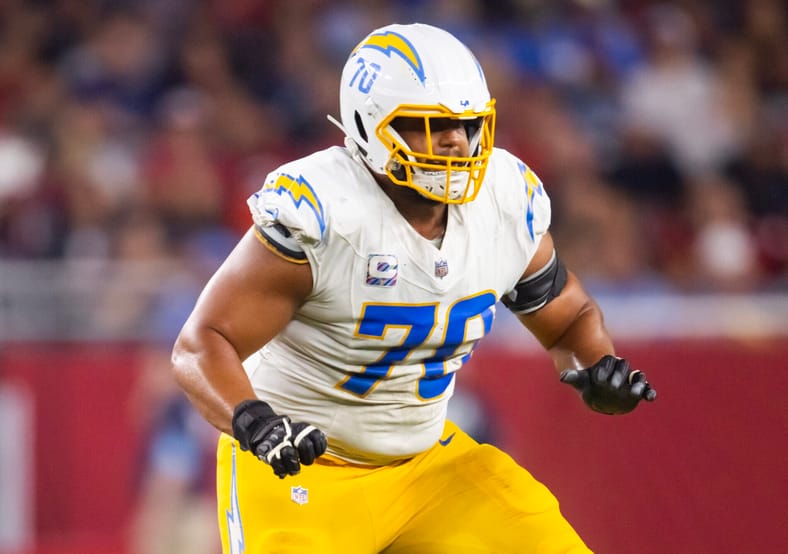
While Slater’s progress is encouraging, the nature of his injury — a torn patellar tendon — carries long-term implications that extend far beyond a single rehab timeline.
On The Athletic Football Show, analyst Robert Mays placed Slater’s injury in a sobering historical context.
“Like you said, Icky Ekwonu has a torn patellar tendon. We’re probably going to say this multiple times on the show, but it’s a devastating injury for anyone — and it’s happening with alarming frequency among offensive linemen.
“When you look at the numbers, only about 55 percent of players who suffer this injury even make it back onto the field. And when you dig into the historical medical data, it’s clear just how serious it is.
“Rashawn Slater is another offensive tackle dealing with a torn patellar tendon. His injury happened in training camp, so optimistically, maybe he’s ready by the start of the season. But when researchers looked at this by PFF grade, only about 35 percent of players returned to their prior level of performance within two years. For a lot of guys, this is a career-altering injury.”
Mays did note that successful recoveries are possible, pointing to Chiefs tackle Josh Simmons as a recent example. Still, the data paints a stark picture: even when players return, very few do so at the same level.
For the Chargers, that reality tempers any early optimism.
Is Jim Harbaugh The Real Life Ted Lasso?
Stability at Left Tackle Changes the Offseason Math
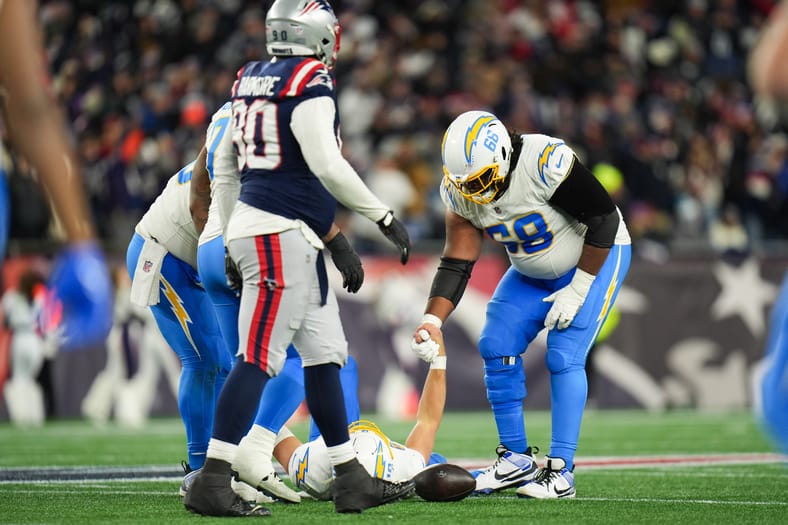
Even with those concerns, Slater’s projected return provides the Chargers something they lacked all season: clarity.
After Slater went down in training camp, the Chargers cycled through nearly every conceivable solution. Trey Pipkins and Bobby Hart rotated in-house. Trevor Penning was acquired at the deadline in a last-ditch attempt to stabilize the edge. None of it worked.
The offensive line’s inconsistency became a defining flaw — and a major reason the Chargers are now in offseason mode.
Knowing Slater could be back by camp gives general manager Joe Hortiz and head coach Jim Harbaugh a critical reference point as they reshape the roster. With fellow bookend tackle Joe Alt’s injury timeline still uncertain and several linemen facing contract decisions, Slater’s presence anchors everything else.
At just 26 years old and freshly signed to a four-year extension, Slater remains one of the few true long-term building blocks on the roster.
Subscribe to LAFB Network’s Los Angeles Chargers YouTube Channel
What the Injury Exposed Along the Offensive Line
Ironically, Slater’s absence also revealed hard truths the Chargers may have otherwise delayed confronting.
Some players rose to the challenge. Jamaree Salyer, forced into extended action, showed he can be a functional depth piece. Others did not. Penning and Mekhi Becton both struggled mightily, leading to multiple benchings — and ultimately, Penning’s release.
More importantly, the season clarified where the real problems lie.
The Numbers Don’t Lie: Pass Protection Was the Breaking Point
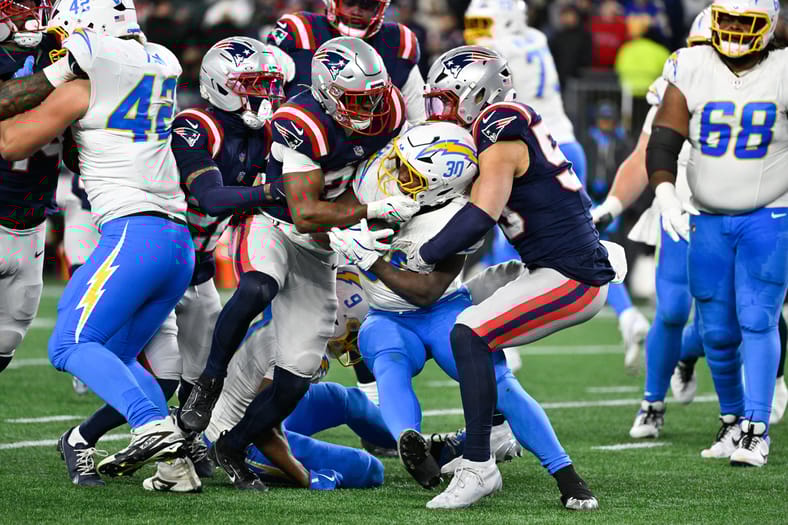
From a statistical standpoint, the Chargers’ offensive line was a study in contrast.
On the ground, they were serviceable:
- 4.44 yards per carry, ranking 13th in the NFL
- 2,067 total rushing yards, indicating consistent lane creation
But in pass protection, the unit collapsed:
- 60 sacks allowed
- 8.76% sack rate, 28th in the league
- 46.86% pressure rate, dead last in the NFL
- Just 0.23 yards before contact per rush, ranking 22nd
Those numbers highlight a unit that could survive in the run game but routinely failed when asked to protect the quarterback — an unsustainable imbalance in today’s NFL.
Interior play remains the most glaring issue. Becton never resembled the All-Pro talent the Chargers hoped to unlock. Bradley Bozeman struggled at center. Zion Johnson, now entering a contract year, showed improvement but remains inconsistent after multiple below-average seasons.
One Answer, Many Questions Still to Solve
Slater’s return does not fix everything — and the Chargers know that better than anyone. But it does provide something invaluable heading into the offseason: certainty at the most important position along the line.
Given the severity of his injury, expectations must remain realistic. History suggests the road back is rarely linear, and peak performance may take time — if it comes at all.
Still, with Rashawn Slater on track for training camp, the Chargers at least know where to start. For a team desperate to rebuild its foundation, that alone is a meaningful step forward.