

The Los Angeles Chargers’ 2024 defensive line was one of the best and most surprising units last season. But the team lost its two top interior defensive linemen, Poona Ford and Morgan Fox in free agency. Heading into the 2025 offseason calendar, the team didn’t spend much capital: neither cap nor draft.
They added seven-year veteran Da’Shawn Hand, who played a career high snaps for Miami last season, and drafted Jamree Caldwell in the third round of the draft.
The Chargers’ defensive line enters training camp with a blend of youth, experience, and untapped potential. At defensive end, veterans Hand and fourth-round rookie Justin Eboigbe lead a rotation that also includes 2023 sixth-round pick Scott Matlock.
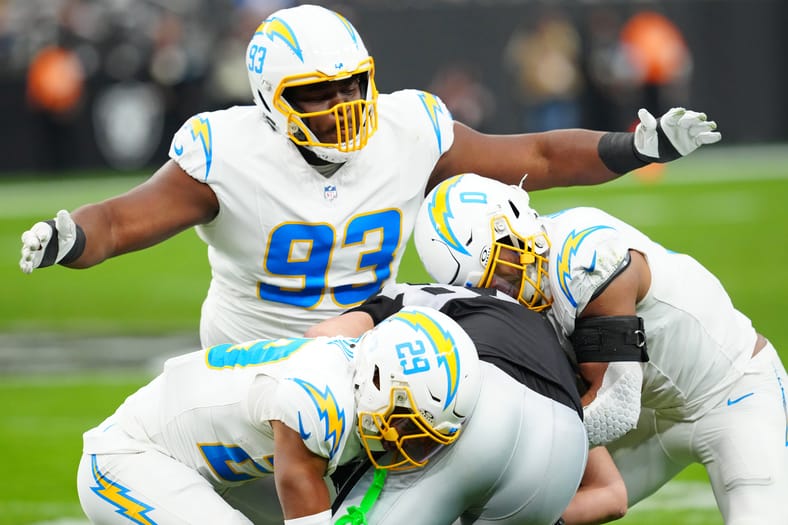
At nose tackle, free-agent addition Teair Tart provides physicality and starting experience, backed by developmental prospects like Jamaree Caldwell and TeRah Edwards.
The interior rotation will prominently feature former fifth-round pick Otito Ogbonnia, veteran Naquan Jones, and possibly recent additions Christopher Hinton and undrafted rookie Josh Fuga.
Chargers defensive coordinator Jesse Minter was able to get a lot from his IDL squad last year, but the question remained: Can he work his magic on a group that has spent less time together and have less collective experience than last years underrated group
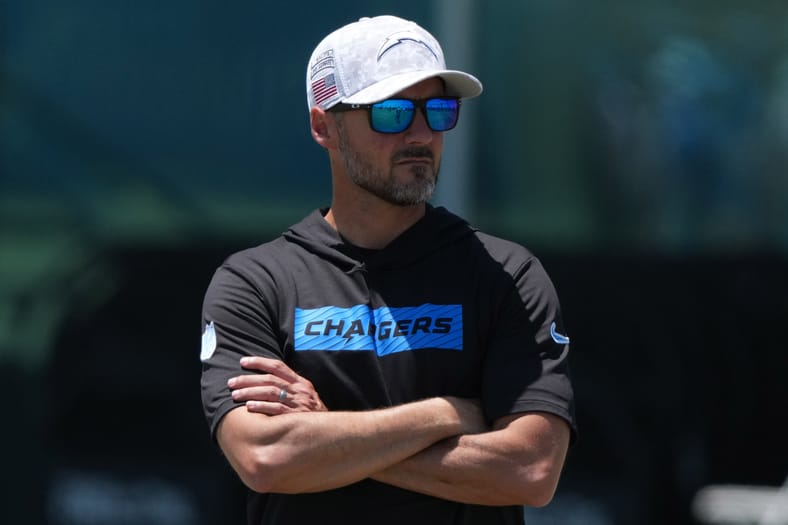
Chargers Training Camp: DC Jesse Minter On Defensive Line Depth And Rotation
Minter addressed the question on Day 2 of Chargers training camp.
“It’s one of our deeper position groups in terms of players who are capable of playing the way we want. It’s going to be fun to watch how it all shakes out over the next few weeks.”
While it lacks a big household name, Minter emphasized the importance of the rotation, which highlights his previous point of players “capable of playing the way we want. Minter went on to emphasize the importance of rotation along the offensive line — expensive, star-laden or not.
“I think that room — like any D-line — thrives on depth and rotation. Just look at the Super Bowl: one guy left and got paid a ton of money, and another guy there is probably about to get paid a ton too.
But even with that high-end talent, it’s still a rotation. Multiple guys play, and I think our group has embraced that.
And at the end of the day, Minter has flattened the rotation, because as he puts it, I look at OTAs and minicamp as not really competition. It’s more you’re chasing execution, you’re chasing learning the system, you’re chasing standards of how you practice. But the real competition amps up when you can press and you can play the ball, and you can be competitive.”
The focus on execution allows for equal opportunity for those who earn it.
“The returning players understand that if they do their job and perform at a high level, they’ll be on the field. And they also know the new guys coming in have that same opportunity.”
Subscribe to LAFB Network’s Los Angeles Chargers YouTube Channel