

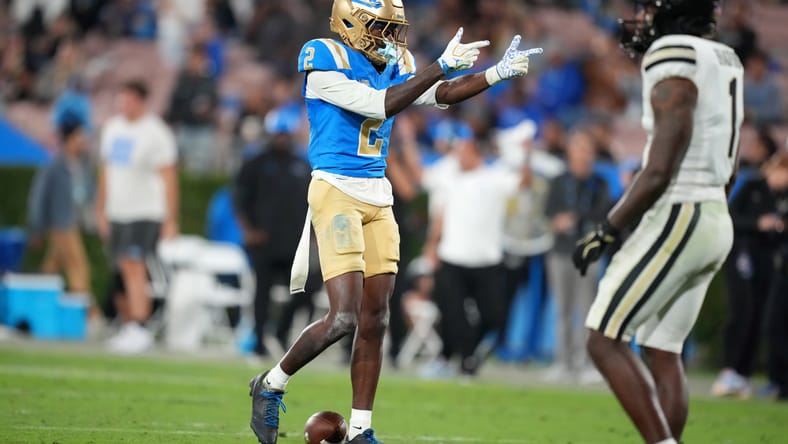
UCLA’s offense has leaned on the run through the first few weeks of the season, and against Purdue, that finally started opening up everything else.
The Bruins finished with 645 total yards, averaged 7.9 yards per rushing attempt and converted 11 of 14 third downs in a 52-38 win over Purdue on Saturday night at the Rose Bowl. UCLA moved to 3-0 for the first time since 2023, but the final score also covered up another uneven defensive performance.
The offense looked comfortable almost immediately.
UCLA opened the game with a seven-play touchdown drive that took just 2:58, getting most of its production on the ground and averaging 10.8 yards per carry. Nico Iamaleava spent most of the possession operating from a clean pocket, and when UCLA did throw, Purdue had to respect what the Bruins were already doing on the ground.
That balance became more noticeable as the game went on.
Iamaleava was willing to attack deeper than he had in UCLA’s first two games, including a 43-yard completion to Bryan Rowe Jr. in the second half. Nico also had his first touchdown pass, with more to follow after. Wayne Knight continued to create after contact, Anthony Woods found the end zone, and the Bruins kept rotating backs without losing much efficiency.
Check Out Our Custom-Designed UCLA Bruins Merch!
Head coach Bob Chesney said the Bruins used their early success running the ball to create opportunities through play action, while also giving Iamaleava enough time to work through his reads.
That showed up in the final numbers. UCLA had 35 first downs, controlled the ball for 36:10 and went 5-for-6 in the red zone. Purdue knew UCLA wanted to run the football and still could not consistently stop it.
Purdue Kept Finding UCLA’s Secondary
The concern came on the other side.
Seven seconds after UCLA’s opening touchdown, Purdue answered with one of the easiest scores it had all night. UCLA brought heavy pressure, Purdue got the ball out quickly, and a receiver had enough room behind the rush to take it the rest of the way.
That became the trade-off UCLA fought with for most of the night.
The Bruins did not show the five-man fronts as frequently after that early touchdown, instead spending more time in a four-man look and using linebackers as additional rushers. That group has enough athleticism to create pressure, and UCLA finished with two sacks and five quarterback hits, but Purdue continued finding opportunities behind it.
At times, receivers simply ran through the secondary uncovered.
Ryan Browne and Purdue finished with 425 passing yards and averaged 13.7 yards per attempt. One second-half touchdown came on another quick throw to an open receiver who took it roughly 30 yards into the end zone.
The defense was not getting beat in one specific way, either. There were pressure looks that did not get home, coverage breakdowns, and penalties that extended possessions.
Chesney said afterward that UCLA’s technique started to break down as Purdue continued attacking the secondary and that the defense could not allow itself to get into “panic mode.”
That fits what the Bruins looked like for much of the night. The defense was capable of creating a negative play and then giving those yards right back.
Sammy Omosigho Was In The Middle Of Everything
Sammy Omosigho probably best represented that up-and-down defensive performance.
He came up with a huge sack on third down and later punched the ball loose for a fumble that Sahmir West recovered. UCLA forced three turnovers without giving the ball away itself, which helped offset how many yards Purdue was able to generate.
Omosigho has now forced a fumble in each of UCLA’s first three games, something Chesney credited to his ability to attack the football without sacrificing the tackle.
But Omosigho was also flagged for roughing the passer, part of a larger discipline problem for UCLA. The Bruins committed 12 penalties for 103 yards.
There were still positive snaps against the run. Scooter Jackson and Malik Hartford combined to stop a Purdue back in the backfield, and despite some early success on the ground, Purdue finished at just 2.4 yards per rushing attempt.
UCLA’s defensive issues were much more damaging through the air.
Nico Took Some Hits, But UCLA Kept Moving
Iamaleava’s performance also came with a brief scare.
He took several hard hits, including a sack where he got rocked, and Madden Iamaleava briefly entered the game twice. Nico eventually returned and continued running the offense.
Chesney said afterward that Iamaleava was “pretty nicked up” during the game but kept pushing to stay on the field. He added that the quarterback should be fine moving forward.
More importantly for UCLA, the offense did not become conservative because of it.
The Bruins continued throwing downfield, continued leaning on a deep running back rotation, and kept answering when Purdue scored. Knight’s touchdown run, where he stayed upright through contact before reaching the end zone, was another example of how difficult UCLA’s skill players were to bring down in space.
That offense carried UCLA through a game where its defense never really settled in.
The Bruins are 3-0, and 52 points with 645 yards against a Big Ten opponent is the clearest sign yet of what this offense can become. The question coming out of Saturday is on defense.
UCLA can pressure the quarterback. It can create turnovers. It has athletes at linebacker who can be used in different ways.
But Purdue also showed what happens when that pressure does not get home.
The Bruins survived it because their offense kept scoring. Against better passing teams on the schedule, they may not have that margin for error.