

Los Angeles Dodgers manager Dave Roberts confirmed Monday what had become increasingly clear throughout a championship season: Mookie Betts will remain the club’s everyday shortstop moving forward. Fabian Ardaya of The Athletic first reported the decision, solidifying one of the most unconventional — and consequential — positional shifts in modern baseball.
Betts’ move was never cosmetic. After transitioning to shortstop full-time in 2025, he posted a plus-6 Outs Above Average, a remarkable defensive mark at the game’s most demanding position. He played just one inning in right field all season, effectively closing the door on any return to the outfield.
Support Local and Independent Sports Writing – Subscribe To the LAFB Network Today!
Doing the Impossible, Quietly
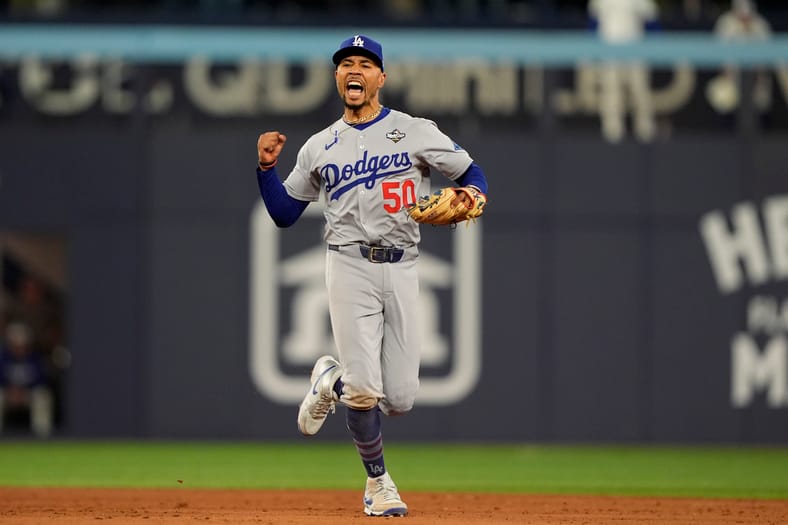
Veteran stars rarely move up the defensive spectrum in their 30s. Betts didn’t just attempt it — he mastered it. At age 32, he turned routine plays into automatic outs and difficult chances into momentum-saving moments. That reliability culminated in the most symbolic play of the postseason: Betts starting the Game 7-ending double play to clinch another World Series title.
Dodgers president of baseball operations Andrew Friedman believes the difficulty of that transition has gone underappreciated.
“For him to play that caliber of shortstop, I think, is underappreciated,” Friedman said. “I don’t think people are paying enough attention to how difficult that was.”
Betts’ defensive excellence earned him a Gold Glove nomination — not as an outfielder, but at shortstop — a distinction that underscores how extraordinary his season truly was.
Vote For Your Favorite Dodgers Duo: Ohtani – Yamamoto, Betts – Freeman, Hernandez – Hernandez
A Season of Adversity
While the defensive performance shone, the year was anything but smooth. Betts battled illness early, losing significant weight after a stomach bug cut short the team’s trip to Japan. Later, a fractured toe, an extended offensive slump, and the loss of his stepfather tested him further.
Still, Betts steadied himself down the stretch, hitting .294/.351/.478 over the final two months. He came through when it mattered most, including a pivotal two-run single in Game 6 of the World Series.
“It felt great to come through for the boys,” Betts said. “Obviously I would love to play well for myself. But that’s kind of irrelevant. I want to play well for the boys.”
Stability Amid Chaos
In a season marked by bullpen instability, pitching attrition, and injuries to key regulars, Betts became the Dodgers’ constant. His successful transition allowed the front office to avoid filling the game’s most expensive position on the open market — no small luxury given the cost of elite shortstops.
As the celebration fades and the dynasty discussion begins, Betts’ move to shortstop may stand as one of the defining choices of this championship era — not flashy, but foundational.